

How to Measure Your Bra Size for a Plus Size or Large Bust (UK Guide)
Most bra size guides are written for an average bust. If you're shopping for an E cup, F cup, G cup, H cup, or J cup — or if your band size runs from 38 to 46 — those guides will steer you wrong before you've even started. The maths is the same, but the stakes are higher: at a larger bust, an incorrectly sized bra causes real problems, from strap dig and back ache to underwires that sit on breast tissue instead of bone. Getting the size right makes an immediate, tangible difference.
The short version: measure snugly under your bust for your band size, then around the fullest part of your bust for your cup measurement. Subtract band from bust. Each inch of difference is one step up the UK cup scale — but note that UK cup sizing uses double letters (DD, FF, GG, HH) between some steps, so the sequence isn't just the alphabet. Read on for the full picture, including the fit checks that matter more than the tape measure.
Why Measuring Matters More for a Larger Bust
About 80% of a bra's support comes from the band, not the straps. For a smaller bust this is easy to under-appreciate; for a larger one it's everything. If your band is even one size too large, the straps end up carrying weight they were never designed for. The result is familiar: deep shoulder grooves, neck and upper back ache, a band that rides up at the back, and a general sense that your bra is working against you rather than with you.
The fix is almost always a smaller band and a larger cup — not a bigger bra all round. Understanding this is the single most useful thing you can take from this guide.
Step-by-Step: How to Measure Your Bra Size at Home
You need a soft tape measure and ideally a mirror. Measure in inches — UK band sizes are inch-based.
Step 1: Measure Your Band Size
Remove your bra or wear a non-padded one. Wrap the tape measure snugly around your ribcage, directly under your bust — where the bra band would sit. Keep it level all the way round and parallel to the floor. It should be firm: tight enough that it doesn't slide, but you can still breathe normally. Exhale normally, then read the measurement.
Round to the nearest even number. That number is your band size. So a measurement of 37" rounds to 38; a measurement of 39" rounds to 40. Band sizes run in even numbers: 30, 32, 34, 36, 38, 40, 42, 44, 46, 48.
One note on methodology: some older guides tell you to add 4 or 5 inches to your underbust measurement. This is a legacy of when bra fabrics were less stretchy. Modern bras are made with elastic and stretch fabrics, and most specialist brands (including those that stock extended cup and band sizes) use the direct measurement — no adding required. If a brand's size chart asks you to add inches, their chart will tell you; otherwise, take the direct measurement.
Step 2: Measure Your Bust
Wrap the tape around the fullest part of your bust — usually across the nipple line. Keep it level across your back. Don't pull it tight: it should sit comfortably without compressing your breast tissue, because compression will make your cup calculation come out smaller than it should. If you're wearing a non-padded bra, lean forward slightly so the cups are fully filled before measuring.
Step 3: Calculate Your Cup Size
Subtract your band measurement from your bust measurement. The difference, in inches, gives you your UK cup size — but you need the UK cup sequence to read it correctly:
1" = A | 2" = B | 3" = C | 4" = D | 5" = DD | 6" = E | 7" = F | 8" = FF | 9" = G | 10" = GG | 11" = H | 12" = HH | 13" = J | 14" = JJ
The full UK cup sequence in order is: A → B → C → D → DD → E → F → FF → G → GG → H → HH → J → JJ → K
The double letters matter. UK sizing uses DD, FF, GG, and HH as intermediate steps — they're not the same as D, F, G, and H, they sit between them. This is where UK sizing diverges from US sizing: a US G cup is roughly a UK FF or G, and a US H is roughly a UK GG or H. If you're buying from a US brand, always check their size conversion chart before ordering.
A worked example: band measurement 42", bust measurement 53". Difference = 11". From the table above, 11" = H. So the starting size to try is 42H.
How to Check the Fit — These Signs Matter More Than the Tape
A measurement gives you a starting point, not a final answer. Bra fit is confirmed by how it feels and sits on your body, not by what the label says. Here's what to look for:
The band should sit level across your back, parallel to the floor. You should be able to fit two fingers underneath it, but it shouldn't move more than an inch or two when you pull it at the back. A new bra should fasten comfortably on the loosest hook — as the elastic relaxes with washing and wear, you'll move to tighter hooks to maintain the same support.
The cups should contain all of your breast tissue without any spilling over the top, sides, or underneath. The underwire (if present) should sit flat against your ribcage at the bottom and around the sides — not on breast tissue. The centre gore (the piece between the cups at the front) should lie flat against your sternum. If it floats away from your body, the cup is too small.
The straps should rest comfortably on your shoulders without digging in or slipping off. If you're tightening the straps to get enough support, the band is too loose. Straps should contribute to lift, not carry the weight.
Common Fit Problems and What They Mean
Straps digging in: Almost always a band that's too large. The band is failing to support, so the straps are overworked. Try a smaller band and a larger cup to maintain cup volume.
Band riding up at the back: The band is too loose — either sized too large, or it's simply worn out. Try the next hook tighter, or size down the band on your next purchase.
Breast tissue spilling over the top or sides: The cup is too small. Go up a cup size (or two), keeping the band the same.
Cups gaping or wrinkling: The cup is too large for your shape, or the style doesn't suit your breast shape. Try a smaller cup, or try a fuller-coverage style which may fill the cup better.
Underwire sitting on breast tissue: Usually means the cup is too small, so the wire is pushed forward rather than sitting at the base of the breast. Go up a cup size. If the wire is too narrow and digs in at the sides, try a wider-wired style.
Centre gore not lying flat: The cup is too small. The cups are being pushed apart by breast tissue that doesn't fit inside them. Go up a cup size.
Sister Sizes: A Useful Tool When Your Exact Size Is Out of Stock
Sister sizes are alternative band/cup combinations that hold the same cup volume. When you go up a band size, you go down a cup letter — and the total volume stays the same. When you go down a band size, you go up a cup letter.
For example, a 40G, 38GG, and 42FF are all sister sizes — the cup holds the same amount, the band fits differently. A 44H, 42HH, and 46GG are sisters of each other.
Sister sizing is useful when a particular size is out of stock, or when one component of your size feels almost right but not quite. If the 38GG fits your cups perfectly but the band is slightly too firm, try the 40G. If the cups fit but the band is a little loose, try the 36H.
The important thing: sister sizing changes how the band feels, not just the label. Don't use it to avoid a correct band size — a firm band is doing its job.
How Often Should You Remeasure?
Bra size changes more often than most people realise. Weight change, hormonal shifts, pregnancy and breastfeeding, surgery, and age all affect both the band and the cup. It's worth remeasuring once a year, or any time your current bras start to feel wrong — digging, gaping, or simply not feeling like enough support.
Many of our customers who've been wearing a 38DD for a decade discover on remeasuring that they're actually a 36FF or 40F. Neither is better or worse — it's just the number that reflects where your body is now.
Measuring in Extended Sizes: 40–46 Band, G–J Cup
Everything above applies at extended sizes too, but a few things are worth knowing specifically if you're shopping in the 40–46 band or G–J cup range.
First, the fit stakes are higher. A heavier bust places significantly more mechanical load on the bra — which means a band that's only slightly too loose causes noticeably more strap dig, and cups that are slightly too small cause more discomfort than they would at smaller sizes. Getting the size right is more important, not less.
Second, the mainstream market generally stops at a 40 band and a G or H cup. If you're measuring into 42+band or J cup, you're almost certainly going to need a specialist retailer. We stock sizes up to 46J at Orchid, and several styles go to 48 in some band sizes.
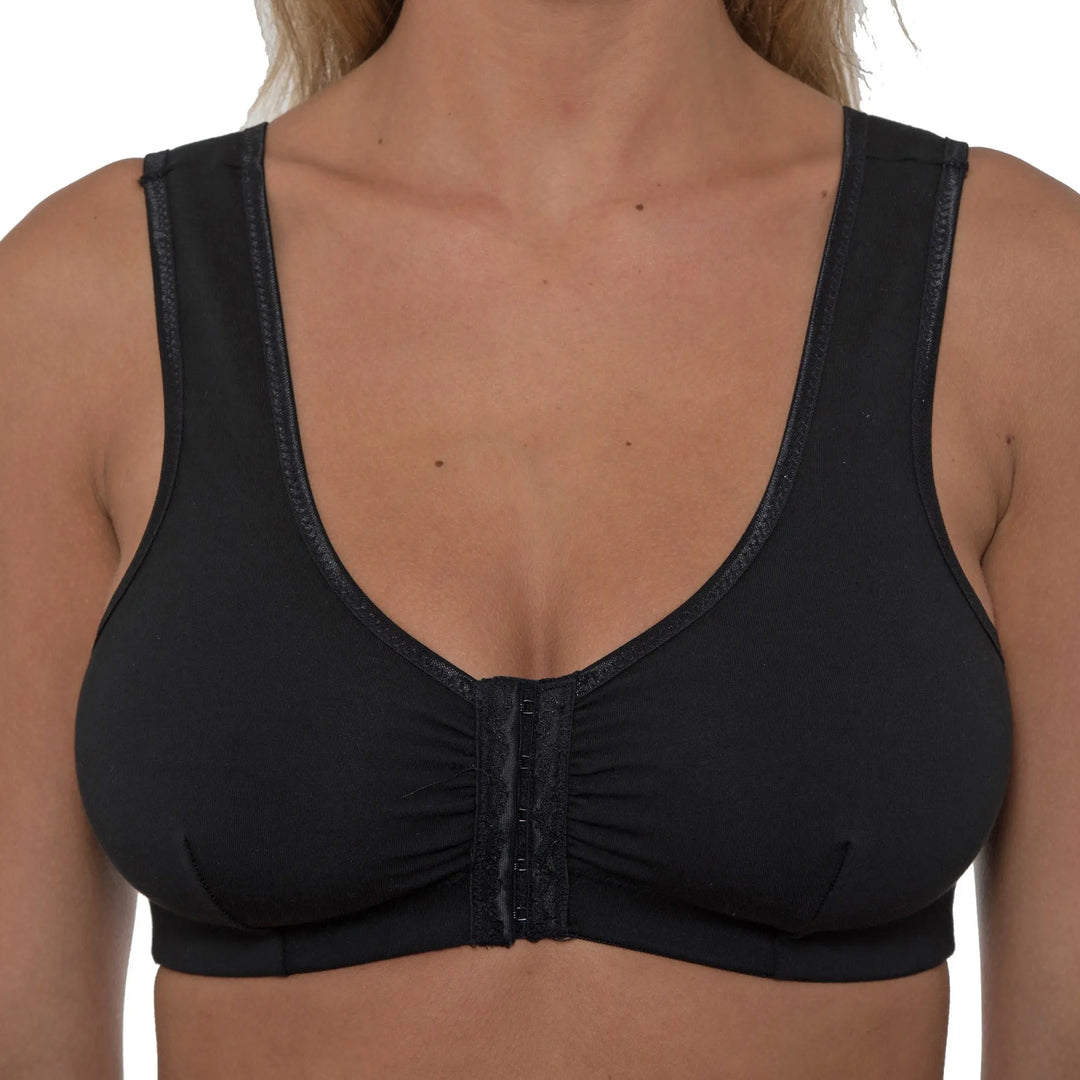
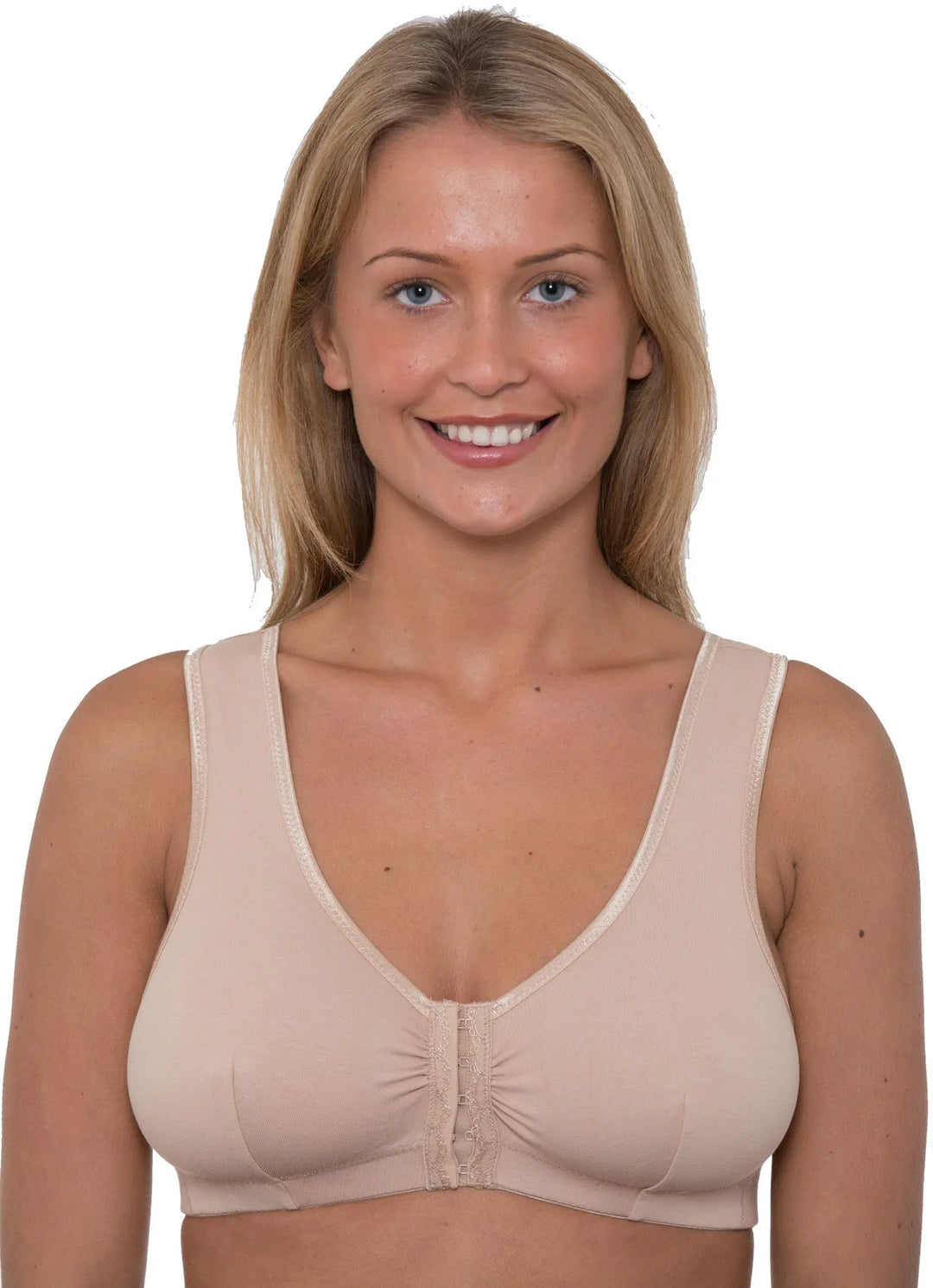
Third, if you're also dealing with limited mobility — arthritis, a frozen shoulder, or age-related changes in grip or shoulder flexibility — the fastening style of your bra matters as much as the size. Our front-fastening and zip-front styles at extended sizes are specifically designed for this. See our guides on adaptive bras for limited mobility, zip-front vs hook-and-eye front fastenings, and easy-to-fasten bras for older women.
Frequently Asked Questions
What is the UK cup size sequence above DD?
After DD, UK cups go: E, F, FF, G, GG, H, HH, J, JJ, K. Each step is one inch of difference between your bust and band measurements. The double letters (FF, GG, HH) are separate sizes, not repeats — FF sits between F and G, GG between G and H, and so on. Don't skip them when counting up.
My band measurement is an odd number — what size am I?
Round to the nearest even number. A 37" underbust rounds to 38; a 39" rounds to 40; a 41" rounds to 42. If you land exactly in the middle (e.g. you measure 38" and feel equally comfortable in a 38 and a 40 band), try both and let the overall fit determine which works better for your shape.
How do I know if my bra band is too big?
The clearest signs: the band rides up at the back, your straps dig in despite being loosened, or you're fastening on the tightest hook from the first wear. If any of these apply, try sizing down one band and up one cup to maintain the same cup volume.
What's a sister size and when should I use it?
A sister size is an alternative band/cup combination with the same cup volume — for example, 38GG and 40G are sisters. Use sister sizing when your exact size is out of stock, or to fine-tune a fit that's almost right. Don't use it to avoid a correctly-sized band: if your 38 band feels snug, that's usually correct — it will relax slightly with wear.
I've been told I'm a 38DD for years but my bras never feel right — what's happening?
This is very common. Most women are measured in mainstream stores that only stock up to a G or H cup, and fitters in those stores often down-size the cup to fit their range rather than recommending an extended size. If a 38DD bra has never felt truly right, it's worth doing the calculation from scratch. Many women in this situation turn out to be a 36F, 36FF, or 36G — or 38E, 38F, or above.
Do front-fastening bras fit differently to back-fastening bras?
The sizing is the same — band and cup measurement work identically regardless of where the bra fastens. The main practical difference is that the centre front panel of a hook-and-eye front-fastening bra does more structural work than a back-fastening centre gore, so fit accuracy matters slightly more. Our guide to front-fastening bras covers this in detail.
I measure into an extended size — where can I find bras that fit?
Orchid Fashion Boutique stocks bras up to 46J, with some styles available to 48 in certain band sizes. We specialise in extended cup and band sizes and stock both back-fastening and front-fastening styles throughout the range. Free UK delivery on every order, and a 30-day no-quibble returns policy so you can try sizes at home without risk.
Shop by Size
Once you have your measurements, explore our range: full cup bras, front-fastening bras, and zip-front sports bras — all stocked in sizes up to 46J, with free UK delivery and 30-day returns.